Test drive Citroen Berlingo 1996 - 2002 Minivan
For the benefit for the case
For many years, the concept of heels was associated with us with an imperishable creation of the Izhevsk Machine-Building Plant and the ancestor of the domestic class of light trucks IZH-2715. The tribe of entrepreneurs, which has arisen in our time, also used this unpretentious old man for its market-and-lane purposes for a long time. Our guests today are a kind of reincarnation of the Udmurt car. They fully reflect the Western vision of commercial machines. This is not just a ton of iron plus the engine. We present to your court Opel Combo, Volkswagen Caddy and Citroen Berlingo cars up to 600 kg.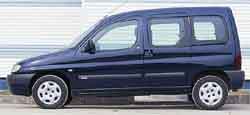 All three cars are completely different: Opel Combo is a cargo, Volkswagen Caddy Cargo -Passero and Citroen Berlingo passenger with wide possibilities for transformation of the salon. Why did we take such a kit for the test? In order to give the opportunity to those who need it, choose a van with the functional set that will be most useful in the household. Opel Combo. The whole-metal van is based on Opel Corsa units, it is also taken from it that a reliable carburetor 8-valve engine is 1.4 liters. This car also has a cargo -passenger version and an option with a low roof of the luggage compartment.
 The driver’s workplace and the passenger’s place are separated from the trunk with a metal partition, which prevents the cargo from entering the salon, which can happen during emergency braking. The driver’s cab itself is the front of Corsa. The instrument panel made of fairly solid plastic with burrs is not devoid of pleasant little things, such as an electronic thermometer and clock. The dashboard is three large and easily readable dials: a speedometer, temperature sensor and fuel level indicator. There are no electric drives, as well as the cover on the glove compartment. Without this, you can live in a traveling car. It is convenient to get a driver of any growth allows a fairly wide set of adjustments, including adjustment of the seat in height, which is carried out using a handle rotating like a handle of a scarlet. Even with basketball growth, the driver does not rest his head against the ceiling, but with his back on the partition. Above the driver’s head is a pocket for trifles and documents, divided into two parts.
 Having settled in a driver’s place, you begin to understand why the drivers of trucks are so strange during the restructuring. Despite even large rear -view mirrors, lateral visibility leaves much to be desired. The view through the back door greatly limits the joint between its equalum wings. It is also upset by the lack of electric drives of external mirrors. The cargo compartment of this modification in the rear axle has a height of 115 cm, in the driver's area 20 cm less. The rear doors are swinging with glazing, but without a heater and wiper. The width of the doorway is 130 cm (this is the best indicator among the participants in the dough), and in wheeled arches per 10 cm less. Combo will transport a load up to 175 cm long without problems (for example, a two -chamber refrigerator), and the loading height of an empty car is 55 cm. Before loading the van, we will pass on a Combo empty.
 The motor was barely audible under the hood, the first gear was turned on. In the cabin, of course, it is noisily audible how gasoline splashes in the tank and rustles tires. On the first empty combin accelerates to 40-45 km/h, after which it begins to protest, demanding a transition to the second. Alas, it should be noted that the gear shift mechanism does not differ with clarity. Nevertheless, along the Combo highway, you can easily disperse to 140 km/h. It is easy to stop the light van, the brake pedal, although soft, but this does not affect the efficiency of braking. A machine that is simply obliged to drive a loaded one with an empty luggage compartment is prone to vertical swaying, and when entering the turn to demolish the rear axle that is not burdened with a load. The suspension is stiff, all joints and other charms are immediately transferred to the body. The vortex of the sensations from steering to Combo does not arise the wrong machine. However, the 69-horsepower engine is characterized by very good traction and even at a speed of 40 km/h and fifth gear confidently disperses the car.
It's time to load. Ballast weighing 250 kg will be enough to understand the difference in the behavior of an empty and loaded Combo. A car with a partially loaded rear axle behaves much more confidently does not swing vertically and does not dance in corners. The acceleration time, of course, is increasing, but not much, and a small, painful heart works as if the car was not loaded at all. With a load of 250 kg, the maximum speed for Combo lies in the range of 120 km/h. Someone will say little, and I believe that this is more than enough, especially for a loaded commercial car. At the same time, fuel consumption in any traffic modes has never exceeded eight per hundred, and A-92. Economic benefit is evident. The only thing that this car clearly lacks is at least some kind of upholstery of the cargo compartment. He is too iron ...
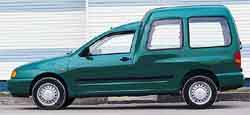 Volkswagen Caddy. Caddy is such a boy in a golf field. The last word can be put in quotation marks, and then the meaning of the phrase will change: Caddy on the run by Golf. It differs from the previous participant in the race with a larger area of \u200b\u200bglazing and the presence of a second row of seats. There is also an all -metal version. A boy for washing the balls, as well as Opel, the flesh from the flesh of the city baby. In this case, the rib was taken from Adam named the Polo of the 94th model year. It also got an injection motor with a volume of 1.4 liters with a capacity of 60 hp. Plus four human. Inside Caddy, the embodiment of German practicality and tender care of Europeans for themselves. A fun and high -quality upholstery of the seats, an ergonomic panel of instruments made of soft material and not a single detail that is not dressed in plastic. The instrument panel (speedometer, large arrow hours, fluid temperature indicator, fuel sensor) and the steering wheel from the base modification of Polo.
 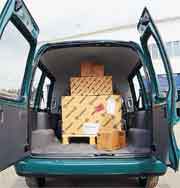 The CADDY driver should be a person no higher than average height, since the height of the roof above the front seats is standard, Polov, and therefore not very large. Driving seats are three adjustments. With their help, you can assume quite conveniently, only one thing will not be enough at least a hint of side support. Here it is completely absent. In the back row of seats, passengers fall through the front ones. The handle of the lifting mechanism on the passenger seat is traditionally in the back, facing the door. But the driver will have to bend, because the same handle on his chair for some reason is located on the inside of the back. Two people of average complexion and any growth can accommodate behind, because the height of the roof above the rear seat of 120 cm. At their disposal, a separate lighting ceiling, head restraints and personal windows. With visibility, due to the larger area of \u200b\u200bglazing, VW is fine. The back door is divided into unequal parts, most is equipped with a wiper, there is a heater.
 Let's make an empty flight. Caddy, like Combo, also does not indulge in the driver with the clarity of the transmission and good course stability in the absence of loading. And the same vertical buildups on an empty machine, excusable for this working ponies. However, the steering in the cargo-passenger folk car operates clearly and sharply, even without hydraulic power. And the same children's delight can be experienced from engine traction. You can get touched from the first three gears, practically without killing the clutch, and on the fifth motor just works miracles. The engine, like a steam locomotive from Romashkovo, only puffs from time to time, but in general it is very confidently pulling the car forward. Since the car is cargo -passenger, to load it, you need to fold the rear sofa. It is possible to do this after removing the rear headrests and a five -minute struggle with the latch. The folding back rests on the front seat, which needs to be moved forward, thereby violating adjustments. It will not be possible to achieve an absolutely even cargo space, for this there is an all -metal version, and in everything else ... The height of the luggage compartment is 120 cm, the width of the doorway 120, in wheel arches 110 cm. Loading height of an empty car 60 cm. Barrel with butter is better Do not put, otherwise you can scratch plastic and ruin the fabric upholstery. Caddy is better to load with boxes, which we will do.
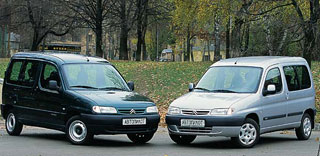
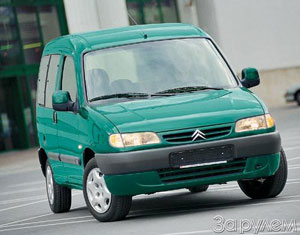
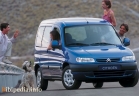
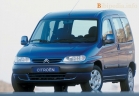
 250 kg in the trunk noticeably worsen the dynamic characteristics of the engine. It is no longer so vigorously disperses the car, but still perfectly pulls in the lower speed range. Loaded Caddy for a liter and a half-turning itself without cargo: 8.5 l/100 km with an empty trunk and 9-10 liters with full. Gasoline, which is nice, 92nd. Caddy, unlike Opel Combo, is not such an unconditional truck, however, in addition to transporting small batches of goods, it is great for traveling to the garden plot, and for a small company to leave the river and barbecue. Citroen Berlingo, aka Peugeot Partner, aka Doninvest Orion. Absolutely independent and original design of the PSA concern. It is also produced in a whole -metal version, as well as in the option with three doors. This is not just a van, but almost UPV. The layout of the body is bus, the rear doors are sliding, and the fifth rises up. 1.4 liter engine with a capacity of 75 hp, maximum load capacity of 550 kg. Inside, this car is even more original and peculiar than outside. Orange-blue upholstery of seats and door panels, blue dials and a blue marble insert on a dashboard. Everything is so cheerful and vividly that in the car you want to sing and have fun, and not carry cargoes. And have to ...
  Five -seater salon with the possibility of transformation and the same height of the roof along the entire length. The driver's place is more like a wagoned tram. The driver sits, as it were, over the dashboard, controls and practically sees the front bumper. At the same time, a tall man risks not to see the upper parts of the dials. There are four adjustments of the driver's seat, and the height of the salon and the design of the front seats allow any Arvidas to feel a full -fledged sabonis. The instrument panel is pleasant to the eye and extremely functional. A set of devices consists of a speedometer, a tachometer with an electronic clock and a standard set of two signs. In addition, there is air conditioning, immobilizer and front electric windows. Passengers fall into the groundwear through not very wide sliding doors and slightly touch the rear wheels arch. Inside their services, numerous windows, a cup holder and pockets under the little things. An empty Berlingo on the road is a good front -wheel drive car with clear reactions on the steering wheel and effective brakes. Since it is the most powerful in our cramped company, it gives it quickly, and its maximum speed is above 150 km/h. Berlingo's rear suspension is completely independent, which saves him from swing and troubles when entering the turn. Carefully removed strips of asphalt and open sewer hatches, a small bus skips like clockwork, swinging on its screw springs and gas shock absorbers.
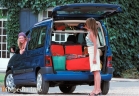
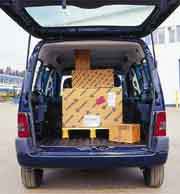
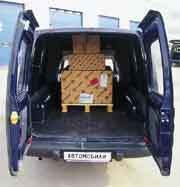
 The disadvantages of his business are immediately found, most of all this applies to visibility back. Imagine that the rear -view mirror on the windshield is located at a distance of 75 cm from the upper point of the instrument panel. That is, in the hatch (hypothetical) that there is no difference in the mirror. All the same, you have to stretch your neck in a guns. The process of folding the rear seat takes a couple of minutes. The headrests are cleaned in the back, and the seat disappears without visible problems. It turns out a cargo platform with an even floor with a length of 140 cm and a width of 117 cm (both in the doorway and in the wheel arches). The loading height is 60 cm. We could not put the barrel in the trunk, the fifth door, which opens almost parallel to the ground, prevented us, but our boxes came in handy this time. 250 kg is this load that Berlingo practically does not feel. The engine, however, becomes more capricious for the selected gear, and the fuel consumption significantly increases 10 liters against 8.5 idle. And again, gasoline ... That's right, the 92nd! Berlingo An ideal family car for a farmer.
All three cars are completely different, they are distinguished by completely different life credo: Opel hard worker and ascetic, Volkswagen also likes to work hard, but tries to do it in white gloves, and Citroen the head of a large family, not sensing hard work. Which is closer to you and dearer? Choose ...
Maxim Rakitin
Photo by Alexander Nozdrin
How do they look:
Nikita Rozanov
Outside:
I will immediately make a reservation that the measurements of the hers on how they look like the trinity of these utilitarian car carriers were used carefully and without emotion. After all, it is unlikely that anyone will buy a hammer not by weight and seizure, but only based on its color. Although, however, someone may need a bright red tool so as not to forget it and not confuse it with a neighbor.
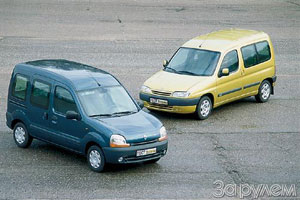
It is difficult to confuse these cars, especially Citroen stands out, which in a cargo -passenger modification looks like a comfortable minivan rather than a utilitarian van. But both Opel and VW true hard workers, having a humpbacked silhouette of a real heel, indicating the priority of the function of transporting goods, and not passenger luggage.
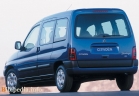
The recognition of cars from the face is good, and in the case of Opel and VW, it owes the long -known ancestors of these vans: Corsa and Polo hatchbacks with branded radiator facilities and a characteristic expressive gaze of headlights. True, VW stands out here, whose bumpers painted in the color make its appearance somewhat playful in comparison with the functionally black-lip bumpers of Citroen and Opel. The same two cars and more functional in detail: Citroen has a wide protective plastic belt, and the Opel cargo volume is decorated with expressive stiffeners. Although the most utilitarian silhouette of Opel, in which the aerodynamic fairing of the cargo compartment protruding upwards brings business and dynamics to the image of the car, Citroen looks more functionally justified, having a sliding side door in the cargo compartment. In the back, the design of such cars is determined exclusively by the design of the doors and the size of the opening, and whatever the rest gets what will remain. The rear optics of the entire three is functional, but is low, and Citroen looks most organized and stylishly behind, the design of which once again confirms that we are more likely a van than a small indoor truck.
Results:
Citroen Berlingo (in the modification of an all -metal van) expressive design is perfectly associated with two brands of manufacturers: Citroen and Peugeot. It has the most convenient and rational loading-unloading scheme, as well as a pronounced utilitarian orientation of the general style and details. Opel Combo is good and in German, a reasonable design, in which the purpose of the car is easily guessed, and the stylistic heredity of the Corsa model is very emphasized by the utilitarianism of the rebellious car. Volkswagen Caddy in comparison with the rest of the review participants, this van does not look so harmonious, and the marriage of the Polo hatchback with a covered cargo platform (especially its glazed version) gives the impression of a not quite equal marriage
Inside:
Evaluation of the interiors of this three is similar to an assessment of appearance to the contrary. Citroen Berlingo is somewhat surprised by the fact that although it successfully combines the functions of Van and Van in its appearance, the instrument panel has a purely hatch-Bekovskaya, the style and composition of which do not really correlate with the needs of a commercial car. The functionalism of the Polo instrument panel more came to the place, and its verified and a little dry design is almost what the transported car needs. Compared to them, Opel itself utilitarianism plus a little spicy style. A wide tray of a comfortable upper shelf in the entire width of the panel and the expressive shape of the two -spoke steering wheel work on this image. The upholstery of the doors is also the most characteristic of German cars. Both Opel and the VW case of the door opening handle organically go into the handle of its closing, and then into a convenient armrest, and all together it looks like a single and functional block.
Results:
Citroen Berlingo The interior of this car is designed to satisfy two purposes: Veng and Furgon. 50/50 did not work, although everything is whole and even stylish. Opel Combo, although the instrument panel was taken from the Corsa Passenger model, it came up both in style and in utilitarian equipment and decoration. Volkswagen Caddy in a Social-specific interior Polo came in handy. True, there are almost no shelves, pockets and containers in it, but this drawback is somewhat compensated by the technological and quality techniques.
Source: Cars